About
A living map of shared experience.
The internet gives us access to more information than ever before, yet it often leaves us feeling disconnected from the places, people, and experiences behind it.
Most online platforms are designed around attention. Algorithms decide what you should see. Advertisers compete for your focus. Popularity often determines visibility. Over time, these incentives shape not only what information is available, but how we experience the world itself.
Consensus Atlas begins with a different idea.
What if we built a platform around curiosity instead of attention?
What if people could explore the world through the observations, experiences, and perspectives of other people — organized by place and time rather than by popularity?
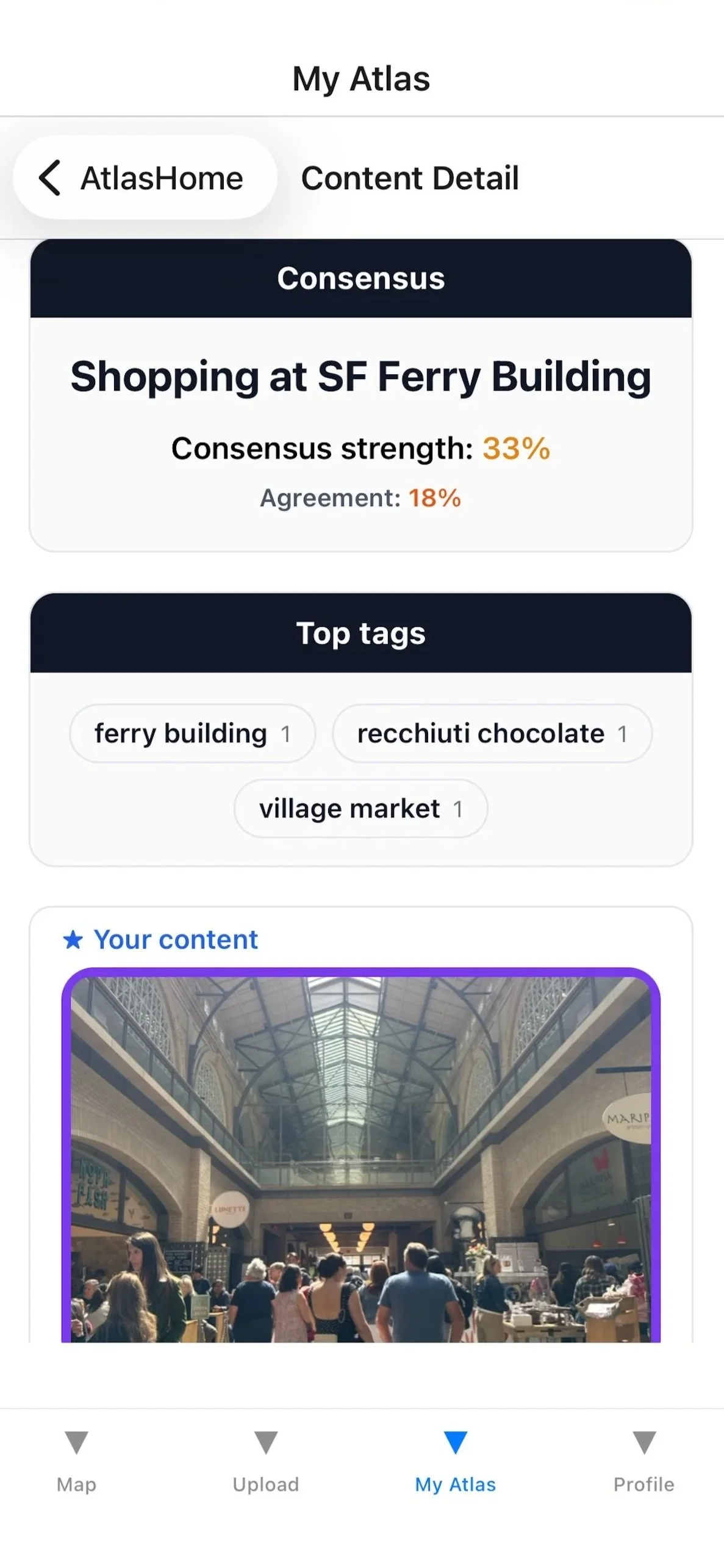
Users can contribute photos, videos, observations, recommendations, and discoveries tied to real places and moments in time. Together, these contributions create an evolving archive of how people experience the world.
What it is
At its core, Consensus Atlas is an attempt to preserve something the internet often loses: context.
Every contribution is connected to where and when it happened. Over time, these individual observations accumulate into something larger — a shared record of places, events, communities, and experiences.
The long-term vision is to create a global archive of human knowledge, memory, and perspective that anyone can explore.
Not a feed.
Not a popularity contest.
Not another platform competing for your attention.
A tool for exploration.
A map of what people have seen, learned, experienced, and discovered.
An experiment in helping us understand the world together.
You might use it to:
Explore how a neighborhood has changed over the years
Discover local recommendations that aren’t shaped by advertising or influencers
Follow bird migrations, wildflower blooms, or other ecological observations
Build shared albums with friends and family that document trips, events, and memories
Learn what daily life is like in another part of the world through firsthand perspectives
Document public events from many viewpoints instead of a single camera angle
Create collections of favorite places, hidden discoveries, and local knowledge
What makes it different
No likes or follower counts
One contribution per user, per item
Emphasis on description, not reaction
Collective outputs instead of individual ranking
The system is designed to reduce performative behavior and encourage thoughtful input.
Where it is now
Consensus Atlas is in an early stage of development. The current focus is on building the map-based archive, refining the user experience, and exploring new ways to organize and understand place-based information.
Much of the work ahead is about learning what works—and what doesn’t.
The Bigger Vision
Consensus Atlas began as a simple idea: what if people could build a shared map of experiences, observations, and discoveries?
But the long-term vision extends beyond maps.
The internet has become extraordinarily good at distributing information, yet surprisingly poor at helping people understand it together. Most systems reward attention, engagement, and individual visibility. Few are designed to help groups build shared understanding over time.
Consensus Atlas is an exploration of a different possibility.
Can we create systems that help people contribute knowledge, compare perspectives, identify patterns, and gradually build a richer understanding of the world together?
Over time, the same principles could be applied to many kinds of collective knowledge—from local communities and ecological observations to historical archives, research projects, and public understanding of complex events.
The goal is not to tell people what to think.
The goal is to create better tools for exploring, documenting, and understanding the world together.